Belzerg has solved problems that would occupy our scientists for centuries. Its healers repair living tissue in seconds. Its wizards move people across great distances without traversing the space between them. Death itself is negotiable. Yet the adventurers responsible for these achievements frequently cannot pay for dinner. Somewhere between the discovery of magic and its application to civilisation, we seem to have missed a step.
I think we should establish a regulator of magic, modelled on the Financial Industry Regulatory Authority, or FINRA, which oversees American brokerage firms. I appreciate that this may sound an oddly terrestrial response to a world containing gods. Having spent some time with the gods, I am more convinced of it.
The opportunity is extraordinary. A reliable healing service could change what it means to grow old. Teleportation could bring a remote village within reach of a hospital. With sufficient understanding, spells now used to kill large frogs might help us feed people through the winter. But these possibilities depend on being able to trust magic when its most gifted practitioner is tired, distracted, or having an argument with Yunyun.

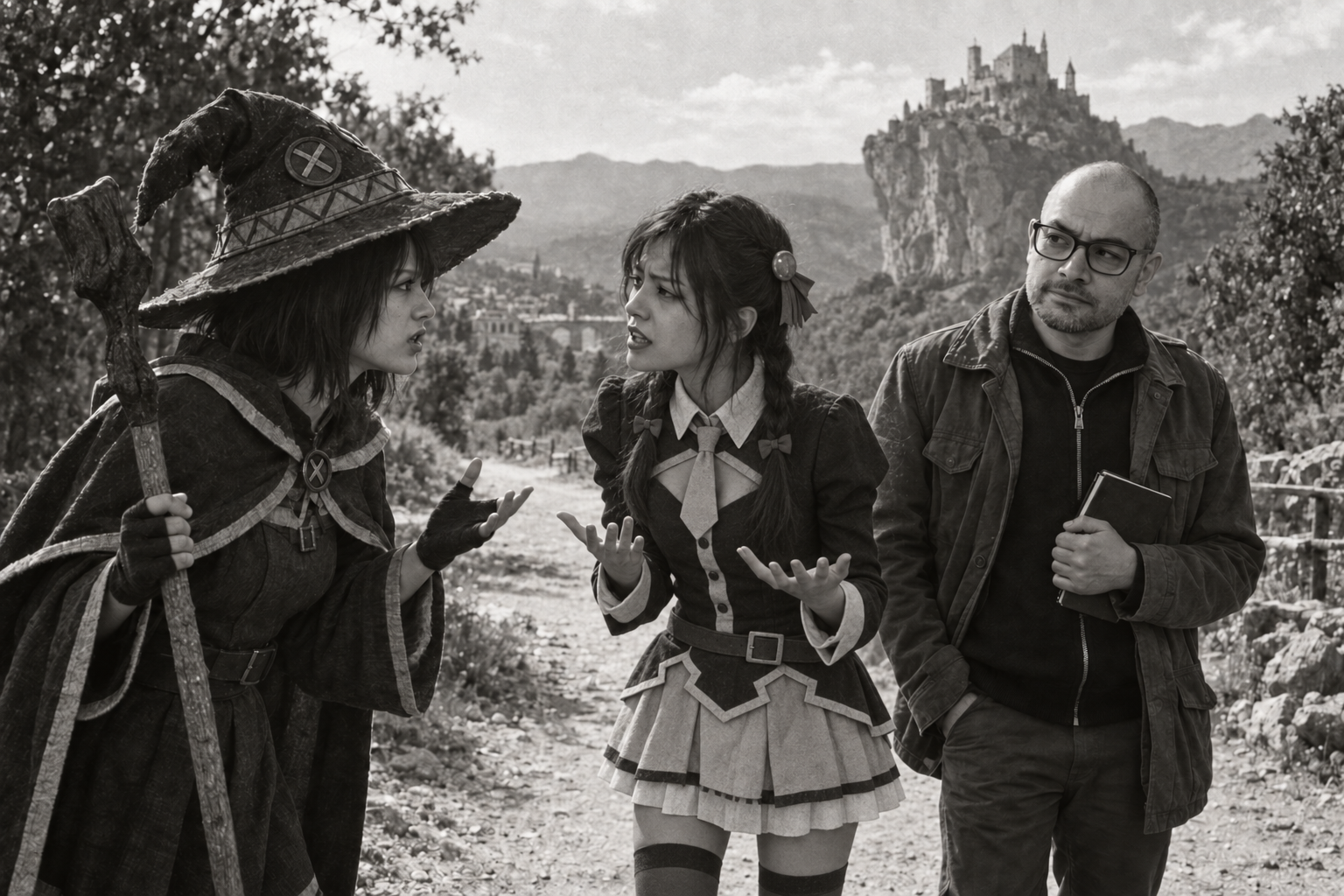
Megumin is a useful place to begin. She has devoted her considerable intelligence to a single spell, Explosion, which renders her unconscious or immobile immediately after use. This is a remarkable technical achievement with a somewhat incomplete deployment strategy. Kazuma usually provides the remaining infrastructure by carrying her home.
I watched her cast from a ridge outside Axel. The valley went white; for an instant the castle appeared to hang inside its own shadow. Then the sound reached us. I have spent my working life trying to understand how intelligence can act upon the world, and here a thought, expressed in a few words, had rearranged a hillside. I wanted to know everything about it. Megumin wanted a score out of ten.
Her adventurer card could tell me her level. It could not tell the stable keeper how far away his horses needed to be. Nor could it tell us whether a larger explosion was simply a larger version of the previous one, or whether some new behaviour would emerge. These are empirical questions. We could investigate them before discovering the answers through somebody’s roof.
At present, experience accumulates mostly inside individual casters. A spell goes wrong, a party survives, and the lesson becomes a story told over drinks. The next party has to survive it independently. Belzerg is paying repeatedly for knowledge it has already acquired.
FINRA offers a useful starting point. It is a private, non-profit self-regulatory organisation, funded by its members and overseen by the US Securities and Exchange Commission. It examines firms, sets qualification requirements and can discipline misconduct. Its relevance here is the combination of professional knowledge and enforceable obligations. A regulator must understand what a wizard is doing well enough to recognise when the wizard is offering an explanation that is mostly an incantation.
A Magic Industry Regulatory Authority, or MIRA, should set a threshold for the power and reach of spells that require a licence. Lighting a cooking fire would remain an ordinary activity. Transporting passengers or destroying a fortification would require demonstrated competence under conditions the examiner controls. A claim to be the foremost genius of the Crimson Demons would be recorded under ‘other information’.
The tests would need to describe particular capabilities. An Explosion assessment should measure the blast radius, how far debris travels and what happens when the caster loses consciousness. A teleportation assessment should establish whether the destination is occupied. A successful demonstration in an empty field tells us very little about a crowded street. I would want independent examiners to vary the conditions and publish the limits of what they had tested.
Casters would report serious incidents and near misses, including successful spells with disastrous consequences. Reports should be available across guilds, with victims able to add their accounts. An honest report should help a practitioner improve; concealing a failure should threaten their licence. We should revise the tests as we learn. Eventually, a new wizard ought to inherit something more useful than the surviving wizards’ confidence.
There is an obvious difficulty. Megumin has very little money. Requiring her to deposit the replacement value of a castle before practising would amount to reserving Explosion for people who already own castles. I would prefer to discover how much talent Belzerg has before making wealth a condition of exercising it.
Guilds and towns should therefore maintain supervised practice grounds, including time for unpaid experimentation. Practitioners would contribute to a compensation fund as they earned fees, with those commissioning dangerous work contributing too. Different activities would need separate risk accounts; a healer should be able to see whether her contributions were subsidising artillery. Claims would have published limits, and the authority would have to restrict work it could not afford to cover. A beginner could still learn without first acquiring a patron.
Someone has to pay after the spectacular part is over. Luna showed me a claim from a man whose house had lost its back wall. The caster had left town. The man had drawn the missing rooms, carefully, as though sufficient precision might cause them to be restored. A useful authority would get an investigator to his house and arrange payment for repairs. We could count the days this took. We could ask him whether the process worked.
I would start with a limited trial in Axel, with the rules and results published before extending it. If injuries fell but entry into the profession collapsed, we would have learned that part of the design was wrong. If the forms multiplied while the claims went unpaid, we would have learned something rather more familiar. The ability to correct the institution must be built into it from the beginning.

Of course, a body financed by powerful magicians could become a powerful magician with an office. Independent public members would need real votes, and residents near practice grounds a route to challenge decisions. The crown should oversee MIRA, with appeals heard outside the guilds. Court magicians would have to accept the same examinations. I would be particularly interested in the king’s commitment to this last point.
Aqua raises a harder question. If a person dies and she brings them back, has the incident been resolved? From the perspective of the party’s headcount, perhaps. From the perspective of the person who died, there may be more to discuss. A system that records only whether the quest succeeded will miss much of what we care about. The testimony of the resurrected should remain on file even when it inconveniences the goddess responsible.
My research on memory and imagination taught me to be cautious about how readily the mind supplies a coherent world. We picture the future using what experience has made available to us. A caster sees an empty field; its owner sees next year’s harvest. Good institutions can bring those futures into the same room. The point of the hearing is to discover what our otherwise excellent model has left out.
I remain deeply optimistic about magic. We have barely begun to ask what a society could become if healing, shelter and travel ceased to consume so much of a human life. There would be new questions about how to spend that life. Some people would study the stars. Some would open shops. Megumin would almost certainly use the additional time to make a larger explosion. A worthwhile civilisation should have room for that ambition, and for the person who would prefer an afternoon’s sleep.
On our last visit to the ridge, we waited while the stable keeper moved his horses. He raised a hand from the gate. Megumin began, and the light passed over the town’s windows, briefly making each one a small white square. Afterwards she asked whether I had heard the echo. It had returned from somewhere far beyond the visible hills. She had been waiting weeks for it. I was glad I had been there.
I would like her to keep listening for that echo. I would like the stable keeper to know when it is coming, and the man with the broken house to sleep through the rain. That is the future I have in mind when I propose a magical FINRA. Somewhere in Axel, a clerk should be able to close a file because the roof has been repaired. Outside, there will still be wonders. ◆
Yunelith Ardo, formerly of the Royal Magic Academy (Examinations)
The capital18 September 2026 · 1The phrase ‘separate risk accounts’ deserves more attention. Explosion has a measurable radius. Teleportation has a destination, and the expensive failures are the ones that prevent the passenger from telling you where it was. The Academy spent three years trying to price these risks. There were too few advanced casters and an unhelpful rate of attrition. If one accident exhausts the fund, which claimant gets paid? I would like to see the proposed accounts before opening my own.
R. Vantrell
Axel, north quarter18 September 2026 · 2The author has never priced a wall. I have. Reconstruction in the north quarter is quoted per breach, and the breaches are the reason the trade exists. Fewer breaches means a smaller trade and a lot of masons drinking at the guild in the afternoons. That may be the right outcome. Nobody has asked the masons. Disclosure: long wall stone, long roof tile, short Aqua. The last position has been difficult to close.
Tobbin (stables, north gate)
Axel18 September 2026 · 3The horses were moved because I moved them. I have asked for a warning bell for two years. Put it by the north gate, ring it before she starts talking, and use the road when you carry her back. They keep cutting across the paddock. You can test every spell in the kingdom and still have to pay for the fence.
Perrault, of the lending library
Alcanretia18 September 2026 · 4I take the point about the house, though the author passes rather quickly from an account of human memory to a recommendation for public hearings. A hearing can also produce a beautifully coherent version of events with the inconvenient parts missing. Who writes the minutes? In Alcanretia I can tell you who writes them, and which deity always appears to have behaved impeccably.
fourth_from_the_door
The guild, back table18 September 2026 · 5Fourteen hundred words to say she should cast it in the lake. Cast it in the lake. Frogs don’t file claims. And you will never get a Crimson Demon to sit an exam that doesn’t award marks for the incantation.
Mireille Hobb
Axel, east lane18 September 2026 · 6We lost the back of our house two winters ago. A travelling caster was showing off at the guild fair and never came back for the bill. We were told to find him. We did not find him. I had to read the part about the fund twice because I thought I had misunderstood. Do you mean we could have been paid even though he left? That would have saved us a winter at my sister’s. Please keep that part.
counter_three
Axel guild18 September 2026 · 7We already keep incident reports. What we cannot do is make another guild read them, compel a caster to return, or pay a claim out of money promised to somebody else. The investigator will need those powers before they need an office. Also, who pays for the supervised practice grounds while the beginners are still beginners? Please do not write ‘the guild’ without asking Luna.
Nerimaki of the Crimson Demons
Crimson Demon village18 September 2026 · 8‘Other information.’ He proposes to put the foremost genius of the Crimson Demons under ‘other information’. I had been prepared to discuss the practice grounds. I am now less prepared.